Shield Recognition · buyer guide
Open versus covered police challenge-coin displays
For worldwide Shield Recognition orders, choose an open challenge-coin display when regular access and rearrangement are priorities, and a covered display when the owner wants a defined enclosure. Compare usable internal space, viewing access and the actual closure. A cover does not by itself establish preservation performance, security or included coins.
Reviewed 2026-09-05 · AI-assisted editorial review. General buying guidance; illustrative scenarios are not customer case studies. Images are AI-generated concepts.
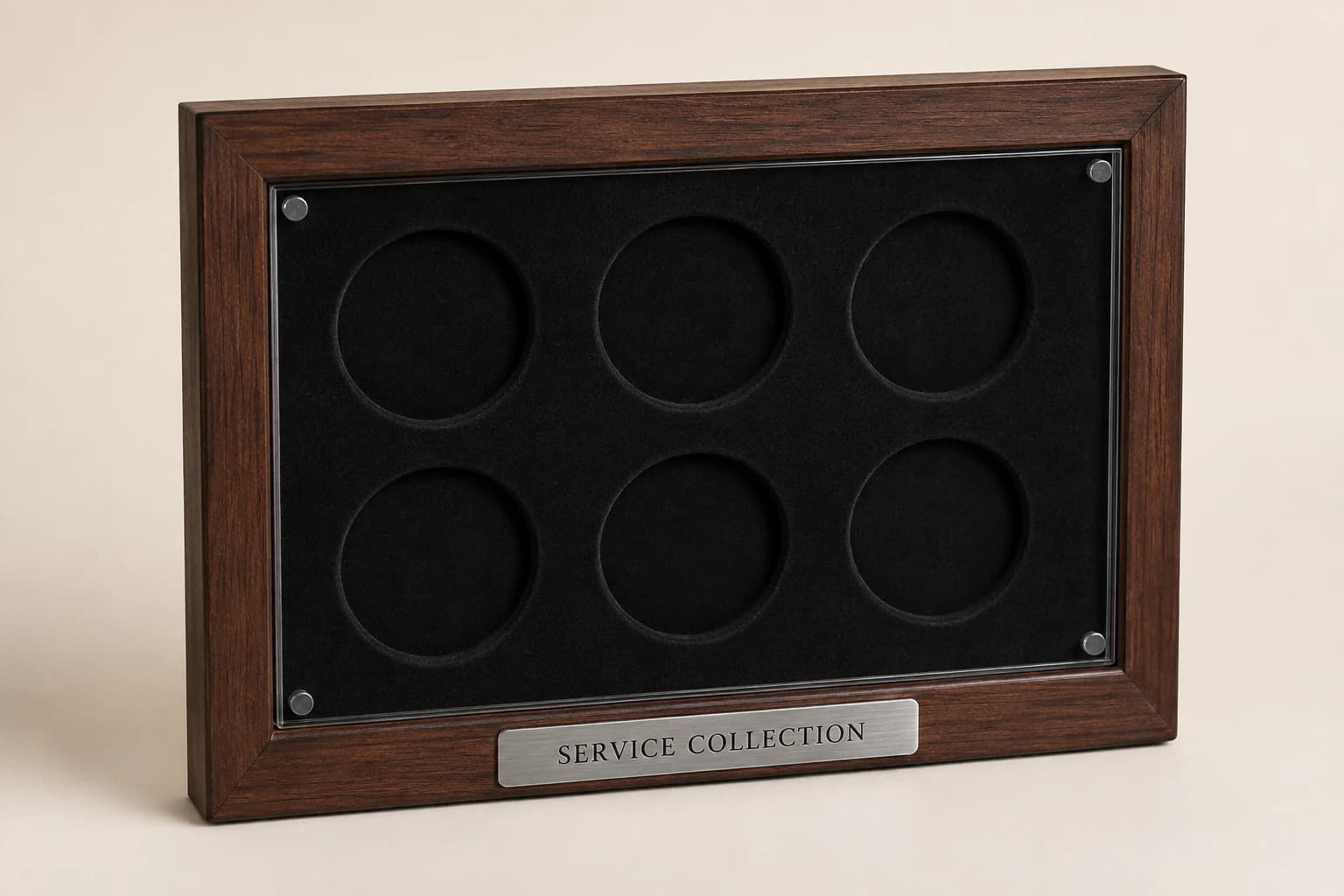
Ask whether the collection is mainly viewed in place or regularly handled, rearranged and discussed. An open arrangement can make a coin easier to reach, while a covered arrangement adds a deliberate access step. Neither is automatically more appropriate for every department office or personal home. The Police Challenge Coin Display Plaque concept provides a relevant starting point, with wood and an acrylic cover described as a design direction rather than a complete fit specification. Identify the actual owner and the intended setting before selecting the construction. This page focuses on the enclosure and viewing decision. It does not establish what a particular coin represents or whether a collection is an official service record.
What must be distinguished from the outside dimensions?
Ask for the usable space available to the coins and their proposed supports, separately from the complete display’s outer dimensions. A frame, door or backing can occupy space that an exterior measurement does not describe. Include the actual assembled coin arrangement when reviewing depth.
A coin’s thickness alone may not represent how far it projects when angled in its holder. Request a drawing that shows the relevant relationship rather than assuming every item fits because its diameter is smaller than the box width. Use one consistent unit and keep unknown internal dimensions on hold. The buyer should understand which measurement governs the collection and which governs the shelf or wall location.

How should the cover and closure be specified?
Identify whether the proposal uses a removable cover, hinged front or another access arrangement, and ask how the owner opens and closes it. A transparent front in a photograph does not reveal its construction or included hardware. If a latch or lock is proposed, describe it as a component rather than a guarantee of security.
The owner should know how access works and which parts are intended for routine handling. Ask the supplier for the instructions appropriate to that actual assembly. Avoid assuming an enclosure is sealed or protective against every environmental condition. The useful quote describes the cover material, closure and support arrangement without turning them into unverified preservation promises.
sfDisplay describes an acrylic front and lockable latches on its specified coin-display cabinet.
Sources: sfDisplay: Flag and Memorabilia Challenge Coin Display Case
Can both sides of the coins be viewed?
Decide whether the owner wants one chosen face visible or expects to turn coins during use. An open slot, a fixed support and a covered compartment can create different access questions. Ask the proposal to demonstrate the desired viewing method with the actual coin dimensions and orientation.
Do not assume that a clear front makes the reverse visible or that every coin can be removed without changing the arrangement. If both sides matter but frequent handling is unwanted, discuss another approved representation or layout rather than pretending the front view answers the whole brief. Keep each coin’s intended visible face in the working record so the display does not accidentally hide the feature the owner wanted to show.


What should be asked about care and preservation?
Request the care instructions and any material-specific performance information for the actual cover, backing and supports. A product category such as acrylic cover does not establish a universal cleaning method, light-protection level or sealed environment. If the coins or accompanying memorabilia have preservation-sensitive value, involve the appropriate specialist and owner before choosing an attachment or enclosure.
The display order should not infer a conservation treatment from a decorative photograph. Keep any specialist recommendation tied to the actual materials and use. For an ordinary decorative collection, the buyer can still ask who will maintain the display and whether that person can use the proposed access arrangement without disturbing unrelated components.
What should a complete open-and-covered quote compare?
Give each proposal the same coin inventory, intended visible faces and display setting. Ask for the complete support arrangement, usable internal dimensions where relevant, cover and closure components, personalization and shipping. Identify any owner-supplied coins separately. No Shield Recognition price range or minimum for this configuration is established here; request those figures for the actual construction.
An open rack price should not be compared with a covered display without identifying the different components and artwork included. If the owner’s priorities change from frequent access to a fixed presentation, update the proposed assembly rather than adding a generic cover to an arrangement whose dimensions were never reviewed for enclosure.

Use the article’s example files
Use the worked comparison as a starting point. Replace its hypothetical dimensions and choices with the supplier’s actual proposal and the owner’s approved requirements.
What should be checked before the collection is installed?
Compare the delivered assembly with its approved component list and keep the owner’s coins under the agreed custody record. Review the cover operation and actual usable space before placing valued objects into the arrangement. Do not modify supports or force a closure to accommodate a dimension that was left uncertain in the brief.
Ask the supplier to address the specific discrepancy. Save the finished display reference and coin orientation map for later additions. A new coin may need another fit and access review even when an unused position exists. The owner should be able to explain how the display opens, what it contains and which parts belong to the purchased assembly.
How does the illustrative product-selection example work?
In a fictional coin-display proposal, the selected coin and its angled support occupy 28 millimeters of depth as an assembly. One covered concept provides 25 millimeters of usable internal depth, while another provides 35. The owner compares those internal measurements before assuming that either enclosure fits from its exterior photograph.
The first concept is short by 3 millimeters; the second leaves 7 millimeters within the stated internal depth. That comparison advances the second for further review and holds the first for a revised support or enclosure proposal. It does not establish a universal clearance, closure tolerance or preservation standard. The supplier must confirm the actual assembled dimensions, and the owner still reviews access and visible faces. The worksheet records the coin-plus-support depth separately from cover depth and exterior size. This prevents a small bare coin measurement from concealing the space needed by the way the collection is actually presented.
Optional calculation: Compare the proposed material descriptions
Which proposed construction fits the intended use?
An open display prioritizes direct access, a removable cover adds an enclosure that is handled separately, and a hinged front provides another access arrangement. Compare the actual support depth and viewing method for each. The construction should fit the owner’s use without assuming a cover automatically supplies conservation performance or security.
| Option | Open coin arrangement | Removable cover | Hinged front |
|---|---|---|---|
| Best reason to choose it | Choose this when the owner wants the approved coins readily accessible for viewing and rearrangement. | Choose this when the owner wants an enclosure and accepts handling a separate cover for access. | Choose this when the proposed access method should retain the cover as part of the display assembly. |
| What the buyer must review | Review the actual support and intended coin faces, including how the complete assembly occupies its location. | Review usable space, cover removal and where the owner places it while accessing coins. | Review opening movement, closure components and the usable internal space with the intended coin supports. |
| What the quote should identify | Identify supports, display base, personalization and any owner-supplied items outside the purchase. | Identify the cover, retained supports and actual assembly instructions without implying a sealed environment. | Identify the hinge and latch arrangement, cover material and complete enclosure dimensions. |
What should you confirm before requesting this product?
Confirm how the owner accesses the coins, which faces should be visible and what usable space the complete supports require. Open and covered displays should be compared from the same collection brief. Ask the quote to identify the actual enclosure components while leaving any preservation or specialized installation question to the appropriate reviewer.
What affects the price of an open versus covered coin display?
Ask Shield Recognition to quote the same collection scope with the proposed supports, cover, closure, personalization and shipping identified. Request the applicable minimum or range. An enclosure adds different components and access questions, so compare complete assemblies rather than assuming the open display’s price includes everything needed for a covered version.
Does a transparent cover guarantee preservation or security?
No such guarantee follows from the category alone. Request the actual cover and closure specifications, care instructions and any supported performance information for the proposed product. A preservation-sensitive collection may need specialist review. Keep a latch or lock described as a component unless a specific supported security claim is part of the accepted proposal.
Can the reverse of every coin be seen through the front?
Do not assume so. Identify the desired viewing faces and whether coins should be removable or turned during use. Ask the actual support arrangement to demonstrate that access. A clear front can show the visible face without making the reverse accessible, and a fixed display may require another approved way to represent it.
Why does the example include the coin’s support depth?
Because the angled coin and support form the assembly that must fit inside the cover. Their hypothetical 28-millimeter depth exceeds a25-millimeter enclosure by3 millimeters and fits within a35-millimeter proposal with7 remaining. The bare coin’s thickness would not describe that relationship. Actual fit and closure still require supplier review.
Are the coins in the concept images part of the purchase?
Treat displayed coins as context unless the written proposal expressly supplies them. Keep the owner’s actual collection on a separate inventory with dimensions and custody details. The display order should identify its purchased supports and enclosure without allowing an appealing image to create an unconfirmed promise about included service memorabilia.
Sources and scope
The sources below support the cited technical details. The ordering workflows are editorial recommendations. Your project specification, price and schedule are established in the written quote and approved proof.
- sfDisplay: Flag and Memorabilia Challenge Coin Display Case · checked 2026-09-05
Which buying guide should you read next?
All buying guidesFor worldwide Shield Recognition orders, turn a badge-shaped concept into an approved artwork brief without implying that every decorative shield reproduces an official badge.
For worldwide Shield Recognition orders, count the physical pieces for each law enforcement recipient without merging distinct awards or duplicating one combined gift.